Today, a review of Simon and Jonathan Forty’s Limits of Empire. Rome’s Borders (2021) dropped into my mailbox, and I wondered if the reviewer and I had read the same book. I certainly didn’t feel that “This book is a nice addition to the literature aimed at a general readership”. However, I must admit that I read it on my vintage black-and-white Kindle, whereas I see (from Google Books) that the 200-page hardback is lavishly illustrated with 350 photographs (many of them from the wonderful collection of Carole Raddato, misspelled “Raddoto” here).
This no doubt swayed the reviewer, who emphasizes the “numerous high-quality pictures and maps which enable the reader to engage with the analysis of evidence more closely” (what analysis of evidence?). In the end, he recommends the book to “those who have no insightful knowledge and familiarity with the history of the Roman frontiers”. On the other hand, those who have such knowledge, he concedes, “might find glitches in it”. This is surely a worrying attitude for any educator to adopt. And I’m not sure that Casemate Publishers should be let off with typographical errors, even if “some of [them] are entirely forgivable”. (I wonder what the reviewer considers to be a “forgivable” error? The “African deserts of Arabia”, perhaps? Or the absence of a warning on the “mosaic from Mogontiacum [showing] the Capricorn symbol of legio XXII Primigenia” that it’s modern?)
The book is clearly intended for the coffee table, so I really shouldn’t be surprised by such gaucheries as “We are lucky that the Romans loved building as much as they liked fighting”; or such platitudes as “the largest collection of written information we have of the Roman world is in their books and letters”; or such banalities as “watchtowers, forts small and large, legionary fortresses: these all have a military purpose as well as potentially providing a customs barrier”. (However, I did enjoy the unintended comedy of aerial photography “unearthing otherwise hidden locations”.) Virtually every statement is qualified and vague; “potentially”, “mostly”, and “usually” conceal the authors’ unfamiliarity with the subject.
Errors abound — my goodness, there are so many —, but it is probably as tiresome to read about them as it is to record them. It’s just a pity that Casemate Publishers think so little of their readers as to sell them a book that is most certainly not “an ideal introduction to the Limesforschung”.
Dr Duncan B Campbell is an archaeologist, ancient historian, and author of The Fate of the Ninth.
Thursday, 16 February 2023
Friday, 10 February 2023
True and false at Mons Graupius, Part One
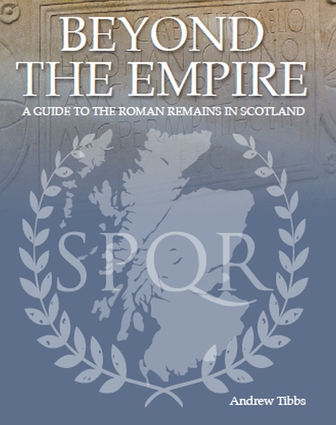
I recently came across the “Romans vs Caledonians” podcast, recorded (in two parts) on 5 September 2021 by Dr Andrew Tibbs. He is there introduced as “an expert on the Romans in Scotland”, no doubt on the basis of his book, Beyond the Empire. A Guide to the Roman Remains in Scotland (Marlborough 2019) and his Durham University doctoral thesis on An Examination of the Location, Intervisibility, Orientation & Interconnectivity of Flavian Fortifications in Roman Scotland (submitted in 2021, but embargoed until 2024, so unavailable). We have seen (in an earlier post) that his book is somewhat unreliable, so I was intrigued to see if the podcast was any better.
It is billed as a discussion of the Battle of Mons Graupius, an event that forms the climax to the vita Iulii Agricolae (“Life of Julius Agricola”) written by the historian Tacitus in AD 98 (the year after he held the consulship), so Dr Tibbs devotes the first 30 minutes or so (Part One of his podcast) to that work. Unfortunately, his knowledge of the Agricola (as it’s known for short) is rather wobbly.
Mainly, he is unwilling to accept that the Agricola is a biography, as this would imply a degree of accuracy that he believes is absent: “I would never really, I think, personally describe it as a biography”, he says. “It is probably best described as, like a play or a film — it’s the edited highlights. You have a beginning, a middle, and an end. You have a big climax, a dénouement. You have an afterthought. So, you know, this is a film of his life, just written down without the pictures. It has elements of truth, it probably has elements of fiction, it’s a bloomin’ good read”. Colourful stuff. But is it accurate?
Dr Tibbs highlights the episode of the night attack on the Ninth Legion, which occurred in the campaigning season prior to the one that saw the Battle of Mons Graupius. Tacitus records that “the enemy massed for a night attack on the Ninth Legion, as being by far the weakest in numbers” (Agr. 26.1: hosti ... universi nonam legionem ut maxime invalidam nocte adgressi). Having sprung the attack, “fighting was already going on inside the camp itself when Agricola, who had learned of the enemy’s route from his scouts and was following close on their tracks, ordered the most mobile of his cavalry and infantry to charge the combatants from the rear” (Agr. 26.2: iamque in ipsis castris pugnabatur, cum Agricola iter hostium ab exploratoribus edoctus et vestigiis insecutus, velocissimos equitum peditumque adsultare tergis pugnantium iubet). As day dawned, Tacitus writes, “finally the enemy were driven back before the rival efforts of two armies, the one wanting to show that it had come to the rescue, the other that it had not needed help” (Agr. 26.3: donec pulsi hostes, utroque exercitu certante, his, ut tulisse opem, illis, ne eguisse auxilio viderentur).
Dr Tibbs wishes to sow the seeds of doubt here. He says that we don’t even know whether the Ninth Legion were occupying a camp or a fort (but Tacitus says it’s a camp) and confusingly claims that “it’s very difficult to prove that they were at this particular site”. (Which site?) He claims that the ramparts were breached (“if defences are breached, and that’s what we’re getting from Tacitus that that’s what happens, they’re going to knock down these ramparts”), but it seems that the enemy entered by the gates. Tacitus actually writes that “they cut down the sentries and burst into the sleeping camp, creating panic” (Agr. 26.1: inter somnum ac trepidationem caesis vigilibus inrupere), and as if to confirm that they had entered by the gates, Tacitus writes that they tried to get back out that way: “they ventured on a break out and a fierce battle followed in the narrow passage of the gates” (Agr. 26.3: ultro quin etiam erupere, et fuit atrox in ipsis portarum angustiis proelium). Finally, Dr Tibbs despairs of ever finding the evidence of the breached ramparts or burned debris that might prove the story and concedes that it is, after all, a movie. The entire episode is dismissed. “So, something may have happened”, he concludes. “The Ninth Legion — the indication is from the literary evidence it was already depleted, because it had been involved in the Boudican Revolt some twenty-odd years before — 15, 20 years beforehand — so it’s difficult to know what was happening. Was this just a rubbish legion that Tacitus decided, right, I need a story, you’re the guys that are going to be, you know. We need to look at it like you would a film”.
I’m not sure that this level of textual criticism, even combined with cinematographic techniques, will help us find Mons Graupius, but perhaps all will be revealed in Part Two of Dr Tibbs’ podcast.
It is billed as a discussion of the Battle of Mons Graupius, an event that forms the climax to the vita Iulii Agricolae (“Life of Julius Agricola”) written by the historian Tacitus in AD 98 (the year after he held the consulship), so Dr Tibbs devotes the first 30 minutes or so (Part One of his podcast) to that work. Unfortunately, his knowledge of the Agricola (as it’s known for short) is rather wobbly.
Mainly, he is unwilling to accept that the Agricola is a biography, as this would imply a degree of accuracy that he believes is absent: “I would never really, I think, personally describe it as a biography”, he says. “It is probably best described as, like a play or a film — it’s the edited highlights. You have a beginning, a middle, and an end. You have a big climax, a dénouement. You have an afterthought. So, you know, this is a film of his life, just written down without the pictures. It has elements of truth, it probably has elements of fiction, it’s a bloomin’ good read”. Colourful stuff. But is it accurate?
The “Ninth Legion disaster”
We can agree, of course, that the Agricola is “a good read”, but Dr Tibbs’ claim that “it probably has elements of fiction” really needs to be substantiated. Which parts are fiction?Dr Tibbs highlights the episode of the night attack on the Ninth Legion, which occurred in the campaigning season prior to the one that saw the Battle of Mons Graupius. Tacitus records that “the enemy massed for a night attack on the Ninth Legion, as being by far the weakest in numbers” (Agr. 26.1: hosti ... universi nonam legionem ut maxime invalidam nocte adgressi). Having sprung the attack, “fighting was already going on inside the camp itself when Agricola, who had learned of the enemy’s route from his scouts and was following close on their tracks, ordered the most mobile of his cavalry and infantry to charge the combatants from the rear” (Agr. 26.2: iamque in ipsis castris pugnabatur, cum Agricola iter hostium ab exploratoribus edoctus et vestigiis insecutus, velocissimos equitum peditumque adsultare tergis pugnantium iubet). As day dawned, Tacitus writes, “finally the enemy were driven back before the rival efforts of two armies, the one wanting to show that it had come to the rescue, the other that it had not needed help” (Agr. 26.3: donec pulsi hostes, utroque exercitu certante, his, ut tulisse opem, illis, ne eguisse auxilio viderentur).
Dr Tibbs wishes to sow the seeds of doubt here. He says that we don’t even know whether the Ninth Legion were occupying a camp or a fort (but Tacitus says it’s a camp) and confusingly claims that “it’s very difficult to prove that they were at this particular site”. (Which site?) He claims that the ramparts were breached (“if defences are breached, and that’s what we’re getting from Tacitus that that’s what happens, they’re going to knock down these ramparts”), but it seems that the enemy entered by the gates. Tacitus actually writes that “they cut down the sentries and burst into the sleeping camp, creating panic” (Agr. 26.1: inter somnum ac trepidationem caesis vigilibus inrupere), and as if to confirm that they had entered by the gates, Tacitus writes that they tried to get back out that way: “they ventured on a break out and a fierce battle followed in the narrow passage of the gates” (Agr. 26.3: ultro quin etiam erupere, et fuit atrox in ipsis portarum angustiis proelium). Finally, Dr Tibbs despairs of ever finding the evidence of the breached ramparts or burned debris that might prove the story and concedes that it is, after all, a movie. The entire episode is dismissed. “So, something may have happened”, he concludes. “The Ninth Legion — the indication is from the literary evidence it was already depleted, because it had been involved in the Boudican Revolt some twenty-odd years before — 15, 20 years beforehand — so it’s difficult to know what was happening. Was this just a rubbish legion that Tacitus decided, right, I need a story, you’re the guys that are going to be, you know. We need to look at it like you would a film”.
The “pantomime villain”
Tacitus writes that, among the Caledonians, a certain Calgacus was “outstanding among their many leaders for his valour and nobility” (Agr. 29.4: inter pluris duces virtute et genere praestans nomine Calgacus), but Dr Tibbs dismisses him as “a storytelling tool”. Clearly, the Caledonian forces required a leader, and it is curious that Tacitus was able to concoct such a bafflingly Celtic name, if he was completely fictional. Nevertheless, for Dr Tibbs, he is “the big pantomime villain that comes in and says, ‘oh, I hate the Romans’.” We can all agree that Tacitus must have composed the speech that he attributes to Calgacus, but Dr Tibbs doubts the man’s very existence: “did he exist?” he asks, before concluding that “We've no evidence. There’s very little there to imply that there was that sort of figure”.I’m not sure that this level of textual criticism, even combined with cinematographic techniques, will help us find Mons Graupius, but perhaps all will be revealed in Part Two of Dr Tibbs’ podcast.
Saturday, 14 January 2023
A gem of a treatise
Deploying a Roman Army, my book on Arrian’s Ektaxis kat’ Alanôn (“Deployment Against the Alans”), was recently reviewed in Ancient Warfare magazine (Vol. XVI, Issue 1) by the editor, Murray Dahm, who noted that “the Array Against the Alans” (as he prefers to call it) “has been dealt with in these pages before (see AW 13.4)”.
Sure enough, in that very issue from 2020 (pictured here), anonymous contributor “Tacticus” presented his take on Arrian’s treatise. Tacticus paints a rather pessimistic picture of the Ektaxis, and overstates the translator’s challenge by claiming that the manuscript is “riddled with lacunae (gaps)” and that “various modern translators fill these gaps with whatever they think might have been there”. This is a parody of the true state of affairs. He provides no bibliography and, although he credits no source for his information, some of the errors he has made suggest that his knowledge of the Ektaxis comes, at least partly, from the deeply flawed précis that Anthony Dent published in History Today in 1974. Unfortunately, this means that his explanation of Arrian’s treatise falls prey to some of the usual misunderstandings (and some novel ones), once again demonstrating why a new translation and commentary was desperately needed.
Arrian says that the vanguard-closers are “the Celtic horsemen”, whom Tacticus (following Dent here) assumes to be the ala II Gallorum, but (as Ritterling realized in his 1902 publication) these are actually the mounted component of the cohors I Germanorum miliaria equitata. Arrian provides an additional clue here, when he says that “a centurion should lead them, just as in the camp”. He is alluding to the fact that the mounted component has been deployed separately from the main cohort, which no doubt remained at base under their tribune, while the horsemen joined Arrian’s expeditionary force under the command of a legionary centurion, seconded for this purpose (a situation that was by no means unusual).
Tacticus claims (again echoing Dent) that “they were followed by allied Armenian foot archers”, but there is no sign of them in Arrian’s text; nor would such troops be welcome here, trailing behind the mounted vanguard. Instead, Arrian introduces a new section with the words “Let the infantry be drawn up behind them”. This is naturally the beginning of the main column, but (like Dent) Tacticus includes them in the vanguard. Again, although Arrian has clearly announced that this section of the marching column comprises only infantry, Tacticus assumes that, for example, Arrian’s “Italians” are the entire cohors I Italica equitata (whom he, incidentally, identifies as the cohors I Italica voluntariorum civium Romanorum, which is possible, although it should be acknowledged that there was also a cohors I Italica miliaria stationed in the region). He also assumes that “each unit should be headed by attached archers”, whereas Arrian actually specifies that the block of infantry should be led by their massed archers.
The men of Arrian’s two legions formed the main part of the marching column, preceded by three important elements. First, “the picked horsemen” (Arrian’s own equites singulares, drawn from the auxiliary cavalry of Cappadocia); second, “the horsemen from the phalanx” (namely, the legionary cavalry, whom Tacticus boldly counts as 200 men, although the sole legionary legate accompanying Arrian would have brought only his own 120 cavalry); and third, the catapults.
However, I have suggested a far subtler identification. Their position “in front of the standard” recalls Caesar’s antesignani (whom I discussed in 2017, in Ancient Warfare Vol. XI, Issue 4). It may well be that Arrian’s akontistai were legionaries who were similarly “chosen for speed”, as Caesar writes, and expediti (“unencumbered” by baggage), so that they were ready for immediate action. There really isn’t any more we can say about them. Tacticus writes that “behind the legions came more allied troops” — “more”, because he mistakenly thought that there had already been Armenian allies in the vanguard. Not so. Arrian is quite clear: “Let the allied force be drawn up behind the hoplite force”, the former being a quaint term for the provincial militia, the latter for the legions. It must be said that Tacticus here dodged one of Dent’s many errors, in realizing that Arrian’s “Apulian infantry”, who came behind the militia, were in fact the cohors Apula civium Romanorum (although he chooses to spell it Apuleia). Arrian elsewhere indicates that this cohort had supplied only 200 men, and Tacticus is surely mistaken to assume that it must have been grossly under-strength; the cohors III Augusta Cyrenaica, for example, also supplied only a detachment. Finally for this section, the “cavalry from the ala II Gallorum and Italian horsemen” whom Tacticus has escorting this part of the column were actually the former ala in its entirety (for some reason, he thought that the bulk of the unit were up ahead with the vanguard) and the mounted component of the cohors I Italica equitata, which he assumed were marching in their entirety ahead of the legions.
If the marauding Alans of the title were to approach Arrian’s army, the legions were intended to halt their advance by presenting a hedge of spear-points, co-ordinated with a barrage of missiles. In Tacticus’ version, “the first three ranks were to lock shields and press their shoulders into them to prevent a breakthrough while the front rank stabbed at horses and riders without pause. (...) The fourth rank were to do something else, but we don’t know what, because of one of the many gaps in the surviving text”. Ironically, there is no lacuna here! Let us read Arrian’s version: “the first three ranks, closing up their shields and bracing their shoulders, should receive the assault as resolutely as possible, in the most compact formation, pressing against each other as firmly as possible. The fourth rank should overshoot the rest; and the third rank should stab or hurl their lances mercilessly at the horses and the men”.
Finally, Tacticus makes no mention of what is perhaps the most interesting aspect of the Ektaxis; namely, the curious archaizing, often quaint terminology that Arrian employs. Why does he call the cohors I Germanorum equitata “the Celtic horsemen”? Or the ala I Ulpia Dacorum “the squadron of the Getae”? Why does he call a pilum a “lance with a long iron part that comes to a slender point”? Why does he refer to the provincial militia as allies and the legions as phalanxes of hoplites? I believe the answer lies in Arrian’s claim to be “the new Xenophon”, for his entire vocabulary harks back to the fourth century BC, a time when anybody referring to a detachment of the cohors III Augusta Cyrenaica might have resorted to a circumlocution like “those of the Cyrenaeans who are present”.
Sure enough, in that very issue from 2020 (pictured here), anonymous contributor “Tacticus” presented his take on Arrian’s treatise. Tacticus paints a rather pessimistic picture of the Ektaxis, and overstates the translator’s challenge by claiming that the manuscript is “riddled with lacunae (gaps)” and that “various modern translators fill these gaps with whatever they think might have been there”. This is a parody of the true state of affairs. He provides no bibliography and, although he credits no source for his information, some of the errors he has made suggest that his knowledge of the Ektaxis comes, at least partly, from the deeply flawed précis that Anthony Dent published in History Today in 1974. Unfortunately, this means that his explanation of Arrian’s treatise falls prey to some of the usual misunderstandings (and some novel ones), once again demonstrating why a new translation and commentary was desperately needed.
Arrian’s Army
In his first section (“Orders for the March”), he has missed the fact (emphasized by Ritterling in his 1902 publication) that the entire vanguard consists of horsemen. Moreover, he seems to imagine that each named body of troops constituted an entire unit, rather than the detachments that they clearly are. Thus, he interprets Arrian’s “Petraian horse archers” as “the cohors III Ulpia Patraeorum [sic] milliaria [sic] equitata sagittariorum (horse and foot archers from Petra)”, when it is quite clear that they are simply the mounted component of the cohort. He makes the same error when he assumes that the cohortes I and IIII Raetorum equitatae are present in the vanguard in full force, when it must only be their mounted component who are here.Arrian says that the vanguard-closers are “the Celtic horsemen”, whom Tacticus (following Dent here) assumes to be the ala II Gallorum, but (as Ritterling realized in his 1902 publication) these are actually the mounted component of the cohors I Germanorum miliaria equitata. Arrian provides an additional clue here, when he says that “a centurion should lead them, just as in the camp”. He is alluding to the fact that the mounted component has been deployed separately from the main cohort, which no doubt remained at base under their tribune, while the horsemen joined Arrian’s expeditionary force under the command of a legionary centurion, seconded for this purpose (a situation that was by no means unusual).
Tacticus claims (again echoing Dent) that “they were followed by allied Armenian foot archers”, but there is no sign of them in Arrian’s text; nor would such troops be welcome here, trailing behind the mounted vanguard. Instead, Arrian introduces a new section with the words “Let the infantry be drawn up behind them”. This is naturally the beginning of the main column, but (like Dent) Tacticus includes them in the vanguard. Again, although Arrian has clearly announced that this section of the marching column comprises only infantry, Tacticus assumes that, for example, Arrian’s “Italians” are the entire cohors I Italica equitata (whom he, incidentally, identifies as the cohors I Italica voluntariorum civium Romanorum, which is possible, although it should be acknowledged that there was also a cohors I Italica miliaria stationed in the region). He also assumes that “each unit should be headed by attached archers”, whereas Arrian actually specifies that the block of infantry should be led by their massed archers.
The men of Arrian’s two legions formed the main part of the marching column, preceded by three important elements. First, “the picked horsemen” (Arrian’s own equites singulares, drawn from the auxiliary cavalry of Cappadocia); second, “the horsemen from the phalanx” (namely, the legionary cavalry, whom Tacticus boldly counts as 200 men, although the sole legionary legate accompanying Arrian would have brought only his own 120 cavalry); and third, the catapults.
The akontistai
Then Arrian says “Let the javelin-men be drawn up in front of the standard of the infantrymen”. Tacticus, by contrast, has the standards in front of the three above-noted elements; and behind all of them, he has “legionary lanciarii and the legionary officers”, before the main body of the legions. Dent made a similar (though not identical) mistake. The legionary officers actually march with the standard (surely the aquila or legionary eagle), and the standard is preceded by men whom Arrian calls akontistai (“javelin-men”). These are the men about whom Murray Dahm (in his Ancient Warfare review) wrote that he “would have liked more discussion”. However, as I point out in my commentary, “the identity of these men in Arrian’s marching column is not clear”. Previous suggestions have included “light infantry companies of both legions” (Dent), Arrian’s pedites singulares (Speidel), a body of velites (Belfiore), and unidentified “spearmen” (Brian Campbell). Since Tacticus later refers to half of each legion as lanciarii, “armed with the lighter dual-purpose lancea”, he seems to envisage Arrian’s akontistai as having been drawn from these men. Murray Dahm follows suit, referring to “lanciarii (called akontistai, ‘javelin-men’)”.However, I have suggested a far subtler identification. Their position “in front of the standard” recalls Caesar’s antesignani (whom I discussed in 2017, in Ancient Warfare Vol. XI, Issue 4). It may well be that Arrian’s akontistai were legionaries who were similarly “chosen for speed”, as Caesar writes, and expediti (“unencumbered” by baggage), so that they were ready for immediate action. There really isn’t any more we can say about them. Tacticus writes that “behind the legions came more allied troops” — “more”, because he mistakenly thought that there had already been Armenian allies in the vanguard. Not so. Arrian is quite clear: “Let the allied force be drawn up behind the hoplite force”, the former being a quaint term for the provincial militia, the latter for the legions. It must be said that Tacticus here dodged one of Dent’s many errors, in realizing that Arrian’s “Apulian infantry”, who came behind the militia, were in fact the cohors Apula civium Romanorum (although he chooses to spell it Apuleia). Arrian elsewhere indicates that this cohort had supplied only 200 men, and Tacticus is surely mistaken to assume that it must have been grossly under-strength; the cohors III Augusta Cyrenaica, for example, also supplied only a detachment. Finally for this section, the “cavalry from the ala II Gallorum and Italian horsemen” whom Tacticus has escorting this part of the column were actually the former ala in its entirety (for some reason, he thought that the bulk of the unit were up ahead with the vanguard) and the mounted component of the cohors I Italica equitata, which he assumed were marching in their entirety ahead of the legions.
Arrian’s Battle
Tacticus’ version of Arrian’s battle array (pictured here) is broadly correct, although it isn’t clear why he labels the cavalry contingents as “ad hoc” units. Arrian refers to “all of the cavalry, drawn up in cavalry squadrons and eight companies”, in order to draw a distinction between the four alae at his disposal (namely, the ala II Ulpia Auriana, the ala I Augusta Gemina Colonorum, the ala II Claudia Gallorum, and the ala I Ulpia Dacorum) and the mounted components drawn from his part-mounted cohorts. Four of these cohorts had supplied only their horsemen: cohortes I Raetorum equitata, I Germanorum miliaria equitata, III Ulpia Petraeorum miliaria equitata, and IV Raetorum equitata. Another three were present at full strength: cohortes I Ituraeorum miliaria equitata, I Bosporanorum equitata, and I Numidarum equitata. And two others (cohortes I Italica miliaria equitata and III Augusta Cyrenaica equitata) had provided detachments, which — brigaded together — made an eighth cavalry contingent. Also, Arrian implies (by the sequence of his text) that the catapults formed a line behind the infantry archers and in front of the cavalry contingents, thus keeping the cavalry well clear of them. And, incidentally, it is likely that Tacticus’s “200 infantry guardsmen [who] acted as Arrian’s personal reserve” were actually his pedites singulares.If the marauding Alans of the title were to approach Arrian’s army, the legions were intended to halt their advance by presenting a hedge of spear-points, co-ordinated with a barrage of missiles. In Tacticus’ version, “the first three ranks were to lock shields and press their shoulders into them to prevent a breakthrough while the front rank stabbed at horses and riders without pause. (...) The fourth rank were to do something else, but we don’t know what, because of one of the many gaps in the surviving text”. Ironically, there is no lacuna here! Let us read Arrian’s version: “the first three ranks, closing up their shields and bracing their shoulders, should receive the assault as resolutely as possible, in the most compact formation, pressing against each other as firmly as possible. The fourth rank should overshoot the rest; and the third rank should stab or hurl their lances mercilessly at the horses and the men”.
Finally, Tacticus makes no mention of what is perhaps the most interesting aspect of the Ektaxis; namely, the curious archaizing, often quaint terminology that Arrian employs. Why does he call the cohors I Germanorum equitata “the Celtic horsemen”? Or the ala I Ulpia Dacorum “the squadron of the Getae”? Why does he call a pilum a “lance with a long iron part that comes to a slender point”? Why does he refer to the provincial militia as allies and the legions as phalanxes of hoplites? I believe the answer lies in Arrian’s claim to be “the new Xenophon”, for his entire vocabulary harks back to the fourth century BC, a time when anybody referring to a detachment of the cohors III Augusta Cyrenaica might have resorted to a circumlocution like “those of the Cyrenaeans who are present”.
Monday, 12 December 2022
Meet the recurring author
I have been a contributor to Karwansaray Publishers’ Ancient Warfare magazine for many years. Recently, the editors asked me to provide a summarized biography for an “author spotlight” feature on their web site. They categorized me as a “recurring author”, a phrase that reminded me of the description of a stalwart actor who, though never the star, pops up now and again for continuity.
Anyway, I tried to keep the biography lightweight but reasonably informative, so that readers of Ancient Warfare magazine might form some idea of who I am. I’m not sure if I succeeded.
Friday, 1 July 2022
Roman Scotland
As a Roman scholar based in Scotland, I was naturally intrigued by a new-ish book entitled Beyond the Empire. A Guide to the Roman Remains in Scotland. It’s an attractive book, printed in colour on glossy paper, but it crossed my mind to wonder if the content lives up to the presentation. Are we sometimes too quick to judge a book by its cover?
The book claims to be “a complete listing of all 330 known Roman sites in Scotland”, with the proviso that “it does not pretend to offer a complete overview of Roman activity in the area” (so are there more than 330 “known” sites?), and the author even suggests that, in future, archaeologists will “perhaps find out that few sites are even Roman”. I’m not sure what he means to imply by this, but many of the “330 known Roman sites” turn out to be, at best, “possible” (e.g. Bridgeness fort, based on “pieces of possible Roman stone”; Ewes Door tower, based on an unexcavated mound “only 30m from an old road that might also be Roman”; Tarbat Ness fort, where “there is no trace of any features on the ground ... [and] there have been no Roman finds”).
The author divides the country into eight parts: the East of Scotland; Mid-Scotland; the West of Scotland; the Southwest of Scotland; the Southeast of Scotland; the North of Scotland; the Northeast of Scotland; and the Highlands of Scotland. This peculiar division means that the Antonine Wall sites are mostly (and logically) found in Mid-Scotland, in chapters headed “Falkirk”, “Dunbartonshire”, and “Glasgow”, but Croy Hill and Mollins thereby find themselves in the Southwest of Scotland, alongside far-off Bothwellhaugh, Castledykes and Little Clyde, in the chapter headed “Lanarkshire”. Since the Antonine Wall elsewhere receives three pages to itself (oddly, in the East of Scotland part), it might have been helpful to include a note in that place (pp. 43-45) indicating where the individual sites could be found.
Each text entry gives the site name (e.g. Dalswinton) followed by the installations to be found there (in this case, Bankfoot fort and camps, and Bankhead fort), along with their National Grid references, so that they can be located on an Ordnance Survey map. Most entries (but not all, by any means) are accompanied by a small road map showing the site location at larger scale. However, I found these difficult to read, partly because the site name is printed in white type with a thick black outline, and partly because all other text (labelling roads, farms, villages) is vanishingly small and appears to be composed of a matrix of dots. These maps, of course, are presumably aimed at armchair readers, since visitors are recommended to equip themselves with the relevant Ordnance Survey map.
Many text entries are accompanied by a colour photograph, which is certainly an attractive feature (again, for the armchair reader), though quite unnecessary (and occasionally irrelevant: p. 59, “Bridgeness, looking north towards the Forth. There may be a fort here somewhere”; p. 90, “Looking northwards, over the River Clyde and towards Argyle and Bute”, presumably from the fortlet at Lurg Moor, which is the subject of that page; p. 95, “Tron Place, Largs: Location of the first post office in the town and possibly the location where some Roman tiles were discovered in 1820”; p. 112, view of a large house through some trees, “There are a significant number of camps, as well as at least one fort, in the area around Glenlochar”).
I found some of the entries to be rather sparse and uninformative. For example, under Carpow, we are told that the fort “is sometimes referred to as a fortress” (it would be helpful to know why) and that “artefactual evidence indicates an occupation date of the early 3rd century, with some speculation that the site was under construction in AD 210” (speculation based on what?). It would have been helpful to point out, firstly, that, at 11 hectares, this is a very large fort (readers are nowhere informed that forts normally cover around 2 hectares and seldom exceed 5 hectares), and secondly, that large quantities of roofing tiles of the Sixth Legion have been found here, on which the legion has the epithet Britannica (“conqueror of the Britons”) (RIB 2460.71-74), probably echoing Septimius Severus’ title Britannicus, which he took in AD 210. Furthermore, coins of Severus (down to AD 207, presumably the year when they were shipped in bulk from Rome to pay the army) were found during the excavation of the site, which was demolished before it was fully occupied, hence the attribution to Severus’ northern campaigns of AD 208-211. Given the length of some other site entries, it’s disappointing that some of this evidence could not have been included.
There are four pages on “Roman Fortifications and Structures” (note that, on the sketch plan of a typical fort, the left and right gates have been switched), and three pages on “Archaeological Techniques”, accompanied by a peculiar negative image of a section of Trajan’s Column, on which nothing whatsoever is discernible.
I found one or two minor matters irritating. The author consistently refers to Caledoni as the inhabitants of Caledonia, whereas ancient authors very clearly named them Caledones or Kalêdonioi, which would be Latinized as “Caledonii”. References are universally omitted, which makes fact-checking rather difficult. In the “Timeline”, we read that “An anonymous Roman text refers to both the Caledoni and the Picts, AD 310”; this must refer to the Panegyric of the Emperor Constantine (Pan. Lat. Vet. VI, 7.2), in which the writer recounts the achievements of the emperor’s father, Constantius Chlorus, vowing that “I shall not speak of the forests and swamps of the Caledones and the other Picts”, implying that, by this date, the Caledones were Picts. Other inaccuracies include the fact that the Chester lead pipe naming Agricola (RIB 2434.1) does not read “This lead pipe was made when Vespasian and Titus were Consuls for the ninth and seventh times respectively, and when Gnaeus Julius Agricola was governor of Britain”, but simply states the consular date and the fact that this was when Agricola was governor. And it is incorrect to say, of the well-known Verulamium inscription (RIB 3123), that “having analysed the use of certain words, epigraphy experts have dated the inscription to around AD 79”; in fact, it is so extremely fragmentary that, owing to gaps in Vespasian’s imperial titulature, it may refer either to AD 79 or to AD 81. Strangely, the emperor Antoninus Pius is consistently referred to as “Fulvius Aelius Hadrianus Antoninus”, which is an eccentric amalgam of his original name (Titus Aurelius Fulvus Boionius Arrius Antoninus) prior to adoption by Hadrian, with the one he held as emperor (Titus Aelius Hadrianus Antoninus Pius). Elsewhere, the via principalis is not “the street that leads from the porta praetoria to the principia”; strictly speaking, the titulus is not “a small bank of earth placed in front of the entrance to a camp”, but a ditch dug in this same position; and claviculae is not a singular noun (as on pp. 104-5). Finally, it is unusual to find Waterfield’s Oxford World’s Classics translation of Polybius listed as one of the two “key classical texts [that] inform archaeologists about Roman activity in Scotland” (the other is Rives’ revision of Mattingly’s Penguin translation of the Agricola).
The book claims to be “a complete listing of all 330 known Roman sites in Scotland”, with the proviso that “it does not pretend to offer a complete overview of Roman activity in the area” (so are there more than 330 “known” sites?), and the author even suggests that, in future, archaeologists will “perhaps find out that few sites are even Roman”. I’m not sure what he means to imply by this, but many of the “330 known Roman sites” turn out to be, at best, “possible” (e.g. Bridgeness fort, based on “pieces of possible Roman stone”; Ewes Door tower, based on an unexcavated mound “only 30m from an old road that might also be Roman”; Tarbat Ness fort, where “there is no trace of any features on the ground ... [and] there have been no Roman finds”).
The author divides the country into eight parts: the East of Scotland; Mid-Scotland; the West of Scotland; the Southwest of Scotland; the Southeast of Scotland; the North of Scotland; the Northeast of Scotland; and the Highlands of Scotland. This peculiar division means that the Antonine Wall sites are mostly (and logically) found in Mid-Scotland, in chapters headed “Falkirk”, “Dunbartonshire”, and “Glasgow”, but Croy Hill and Mollins thereby find themselves in the Southwest of Scotland, alongside far-off Bothwellhaugh, Castledykes and Little Clyde, in the chapter headed “Lanarkshire”. Since the Antonine Wall elsewhere receives three pages to itself (oddly, in the East of Scotland part), it might have been helpful to include a note in that place (pp. 43-45) indicating where the individual sites could be found.
Finding a site
Each part begins with a small location map on which the relevant sites are numbered in alphabetical order. In the subsequent text, the sites are listed alphabetically, but not numbered. This creates a double problem when trying to locate a given site, particularly on a busy map like Dumfries and Galloway; if the reader is trying to find Dalswinton, for instance, the text entry (page 106) has no number, so he or she must flick through pages 99 to 106, keeping a mental tally of the sites as they go past; then, equipped with the relevant number (in this case, 11), the reader must return to the map and scan it from top to bottom, trying to pick out the number 11. Consequently, it might have been wiser (a) to number the sites on each map geographically, perhaps from top left to bottom right, and (b) to number the text entries correspondingly.Each text entry gives the site name (e.g. Dalswinton) followed by the installations to be found there (in this case, Bankfoot fort and camps, and Bankhead fort), along with their National Grid references, so that they can be located on an Ordnance Survey map. Most entries (but not all, by any means) are accompanied by a small road map showing the site location at larger scale. However, I found these difficult to read, partly because the site name is printed in white type with a thick black outline, and partly because all other text (labelling roads, farms, villages) is vanishingly small and appears to be composed of a matrix of dots. These maps, of course, are presumably aimed at armchair readers, since visitors are recommended to equip themselves with the relevant Ordnance Survey map.
Many text entries are accompanied by a colour photograph, which is certainly an attractive feature (again, for the armchair reader), though quite unnecessary (and occasionally irrelevant: p. 59, “Bridgeness, looking north towards the Forth. There may be a fort here somewhere”; p. 90, “Looking northwards, over the River Clyde and towards Argyle and Bute”, presumably from the fortlet at Lurg Moor, which is the subject of that page; p. 95, “Tron Place, Largs: Location of the first post office in the town and possibly the location where some Roman tiles were discovered in 1820”; p. 112, view of a large house through some trees, “There are a significant number of camps, as well as at least one fort, in the area around Glenlochar”).
Fact checking
And then there is the question of content. My usual guidebook, Lawrence Keppie’s The Legacy of Rome. Scotland’s Roman Remains, is now almost 20 years old, so an updated version is certainly to be welcomed, provided it is accurate. One site I have visited recently is the Bearsden bathhouse, which was located in an annexe on the east side of the (no longer visible) Antonine fort, so I am able to correct the text entry where it says that “the fort would have been on the other side of the road” (p. 74), as the road is, in fact, the fort’s via principalis, which ran through the middle. Nor is it clear what the author means when he writes that “the annexe was located where the praetorium (the commander’s house) itself had originally been located to the site [side?] of the original granary”, as the granary lies to the west of the principia, whereas the annexe lies to the east. Finally, given the long-running controversy over Antonine occupation periods, it might have been wiser to say that two phases were identified in the fort, rather than “two periods of Roman occupation”.I found some of the entries to be rather sparse and uninformative. For example, under Carpow, we are told that the fort “is sometimes referred to as a fortress” (it would be helpful to know why) and that “artefactual evidence indicates an occupation date of the early 3rd century, with some speculation that the site was under construction in AD 210” (speculation based on what?). It would have been helpful to point out, firstly, that, at 11 hectares, this is a very large fort (readers are nowhere informed that forts normally cover around 2 hectares and seldom exceed 5 hectares), and secondly, that large quantities of roofing tiles of the Sixth Legion have been found here, on which the legion has the epithet Britannica (“conqueror of the Britons”) (RIB 2460.71-74), probably echoing Septimius Severus’ title Britannicus, which he took in AD 210. Furthermore, coins of Severus (down to AD 207, presumably the year when they were shipped in bulk from Rome to pay the army) were found during the excavation of the site, which was demolished before it was fully occupied, hence the attribution to Severus’ northern campaigns of AD 208-211. Given the length of some other site entries, it’s disappointing that some of this evidence could not have been included.
Additional content
Supplementary material has been added here and there. The book opens with a “Brief Timeline of Roman Scotland”, which for some unknown reason chooses to specify Flavian governors but no others; Lollius Urbicus, for example, is absent. Agricola, we are told, “becomes governor, 77/78-83/84”, presumably hedging bets between an arrival in AD 77 and one in the following year, yet “Agricola secures Scotland as far north as the River Tay, AD 80”; according to Tacitus, this was Agricola’s third season, so, to maintain consistency, ought to be ‘AD 79/80’ here. The Battle of Mons Graupius is placed in AD 83/84 (so naturally, my book Mons Graupius AD 83 does not appear in the bibliography).There are four pages on “Roman Fortifications and Structures” (note that, on the sketch plan of a typical fort, the left and right gates have been switched), and three pages on “Archaeological Techniques”, accompanied by a peculiar negative image of a section of Trajan’s Column, on which nothing whatsoever is discernible.
I found one or two minor matters irritating. The author consistently refers to Caledoni as the inhabitants of Caledonia, whereas ancient authors very clearly named them Caledones or Kalêdonioi, which would be Latinized as “Caledonii”. References are universally omitted, which makes fact-checking rather difficult. In the “Timeline”, we read that “An anonymous Roman text refers to both the Caledoni and the Picts, AD 310”; this must refer to the Panegyric of the Emperor Constantine (Pan. Lat. Vet. VI, 7.2), in which the writer recounts the achievements of the emperor’s father, Constantius Chlorus, vowing that “I shall not speak of the forests and swamps of the Caledones and the other Picts”, implying that, by this date, the Caledones were Picts. Other inaccuracies include the fact that the Chester lead pipe naming Agricola (RIB 2434.1) does not read “This lead pipe was made when Vespasian and Titus were Consuls for the ninth and seventh times respectively, and when Gnaeus Julius Agricola was governor of Britain”, but simply states the consular date and the fact that this was when Agricola was governor. And it is incorrect to say, of the well-known Verulamium inscription (RIB 3123), that “having analysed the use of certain words, epigraphy experts have dated the inscription to around AD 79”; in fact, it is so extremely fragmentary that, owing to gaps in Vespasian’s imperial titulature, it may refer either to AD 79 or to AD 81. Strangely, the emperor Antoninus Pius is consistently referred to as “Fulvius Aelius Hadrianus Antoninus”, which is an eccentric amalgam of his original name (Titus Aurelius Fulvus Boionius Arrius Antoninus) prior to adoption by Hadrian, with the one he held as emperor (Titus Aelius Hadrianus Antoninus Pius). Elsewhere, the via principalis is not “the street that leads from the porta praetoria to the principia”; strictly speaking, the titulus is not “a small bank of earth placed in front of the entrance to a camp”, but a ditch dug in this same position; and claviculae is not a singular noun (as on pp. 104-5). Finally, it is unusual to find Waterfield’s Oxford World’s Classics translation of Polybius listed as one of the two “key classical texts [that] inform archaeologists about Roman activity in Scotland” (the other is Rives’ revision of Mattingly’s Penguin translation of the Agricola).
Saturday, 2 April 2022
A fascinating notebook
The Bibliothèque Nationale de France in Paris has, in its manuscript collection, a 55-page notebook that once belonged to the seventeenth-century classical scholar Claude Saumaise. It is known as Parisinus grec 2539.
The notebook lay largely unnoticed until the 1930s, when the expert French codicologist Alphonse Dain realized its importance as one of only seven surviving copies of an essay written in Greek around AD 135 by the Roman senator Lucius Flavius Arrian. The essay, entitled Ektaxis kat’ Alanôn (“Deployment against the Alans”), only survived from antiquity in a tenth-century codex preserved in the Biblioteca Medicea Laurenziana in Florence.
The codex, or parts of it, were periodically copied throughout the sixteenth and seventeenth centuries. For example, one copy, made by Lukas Holste, was subsequently reworked into a fair copy and written out again in an unfinished bilingual Latin and Greek facing-page edition; all three of these now reside in the Vatican Library.
The Parisinus grec 2539 notebook is fascinating for its marginal comments, surely made by Saumaise himself, where he has attempted to correct mistakes in the grammar and spelling of the archetype.
The Ektaxis kat’ Alanôn is now the subject of a full-length book, in which the corrected Greek text is presented with a facing-page English translation. Some of Saumaise's corrections have been incorporated into this new text.
The notebook lay largely unnoticed until the 1930s, when the expert French codicologist Alphonse Dain realized its importance as one of only seven surviving copies of an essay written in Greek around AD 135 by the Roman senator Lucius Flavius Arrian. The essay, entitled Ektaxis kat’ Alanôn (“Deployment against the Alans”), only survived from antiquity in a tenth-century codex preserved in the Biblioteca Medicea Laurenziana in Florence.
The codex, or parts of it, were periodically copied throughout the sixteenth and seventeenth centuries. For example, one copy, made by Lukas Holste, was subsequently reworked into a fair copy and written out again in an unfinished bilingual Latin and Greek facing-page edition; all three of these now reside in the Vatican Library.
The Parisinus grec 2539 notebook is fascinating for its marginal comments, surely made by Saumaise himself, where he has attempted to correct mistakes in the grammar and spelling of the archetype.
The Ektaxis kat’ Alanôn is now the subject of a full-length book, in which the corrected Greek text is presented with a facing-page English translation. Some of Saumaise's corrections have been incorporated into this new text.
Monday, 13 April 2020
Golvin and Embleton
I have recently been enjoying the web site of the French architect Jean-Claude Golvin. Over the years, he developed a specialism in Roman amphitheatres and an aptitude for re-imagining them in watercolours into a wider project to recreate all manner of ancient and medieval scenes. All of them are wonderful.
I was particularly taken by Golvin’s painting of the Hadrian’s Wall fort at Chesters near Chollerford in Northumberland. It could reasonably be said that this fort is iconic. Having been one of the first to be investigated in the middle years of the nineteenth century, it is a perennial visitor attraction. The reconstruction painting by Ron Embleton is well-known.
It is perhaps unfair to compare it with Golvin’s version. Embleton was pioneering. Both are tremendously evocative.
I was particularly taken by Golvin’s painting of the Hadrian’s Wall fort at Chesters near Chollerford in Northumberland. It could reasonably be said that this fort is iconic. Having been one of the first to be investigated in the middle years of the nineteenth century, it is a perennial visitor attraction. The reconstruction painting by Ron Embleton is well-known.
It is perhaps unfair to compare it with Golvin’s version. Embleton was pioneering. Both are tremendously evocative.
Subscribe to:
Posts (Atom)